Unlimited users on every plan. Search is free. No credit card. Start Free
Apollo vs Clay · 2026

Apollo vs Clay: a database, a workflow tool, or one price for both

Apollo is a contact database with sequences, priced per seat. Clay is a workflow tool that buys data from 150+ providers, paid in actions and data credits. graph8 is the data and the agents that run the outreach, with unlimited users. Prices checked November 27, 2026.
Jump to the calculator
What's your team like?
graph8 Team: $79 a month billed annually, unlimited users Start Free

Prices from each vendor · checked Nov 27, 2026

Which is better

Apollo or Clay: which is better?

The short answer Updated November 27, 2026

They do different jobs. Apollo is a database of 240M+ contacts and 30M+ accounts with sequences built in, priced per seat from $49 a month billed annually. Clay is a workflow tool that buys data from 150+ providers inside tables you build, from $167 a month with unlimited seats, and it can run Apollo inside a table with your own Apollo account. graph8 does the data and the outreach in one place for $79 a month billed annually, with unlimited users.

Our pick

graph8

Teams that want data and outreach run for them

Free search of 700M+ contacts, unlimited users, contact reveals unlimited on Team under fair use, and agents on email, phone, LinkedIn, SMS and WhatsApp.

Price $79 a month billed annually, whole team
Start Free
Best for

Apollo

Reps who search and sequence in one tool

240M+ contacts and 30M+ accounts, as it states. Sequences, a dialer and CRM integrations. Credits pooled per seat; unused credits expire.

Price $49 to $79 a seat a month, billed annually
Best for

Clay

RevOps teams that build their own enrichment

Waterfalls across 150+ providers, unlimited seats and tables. Two usage units, and CRM sync from Growth.

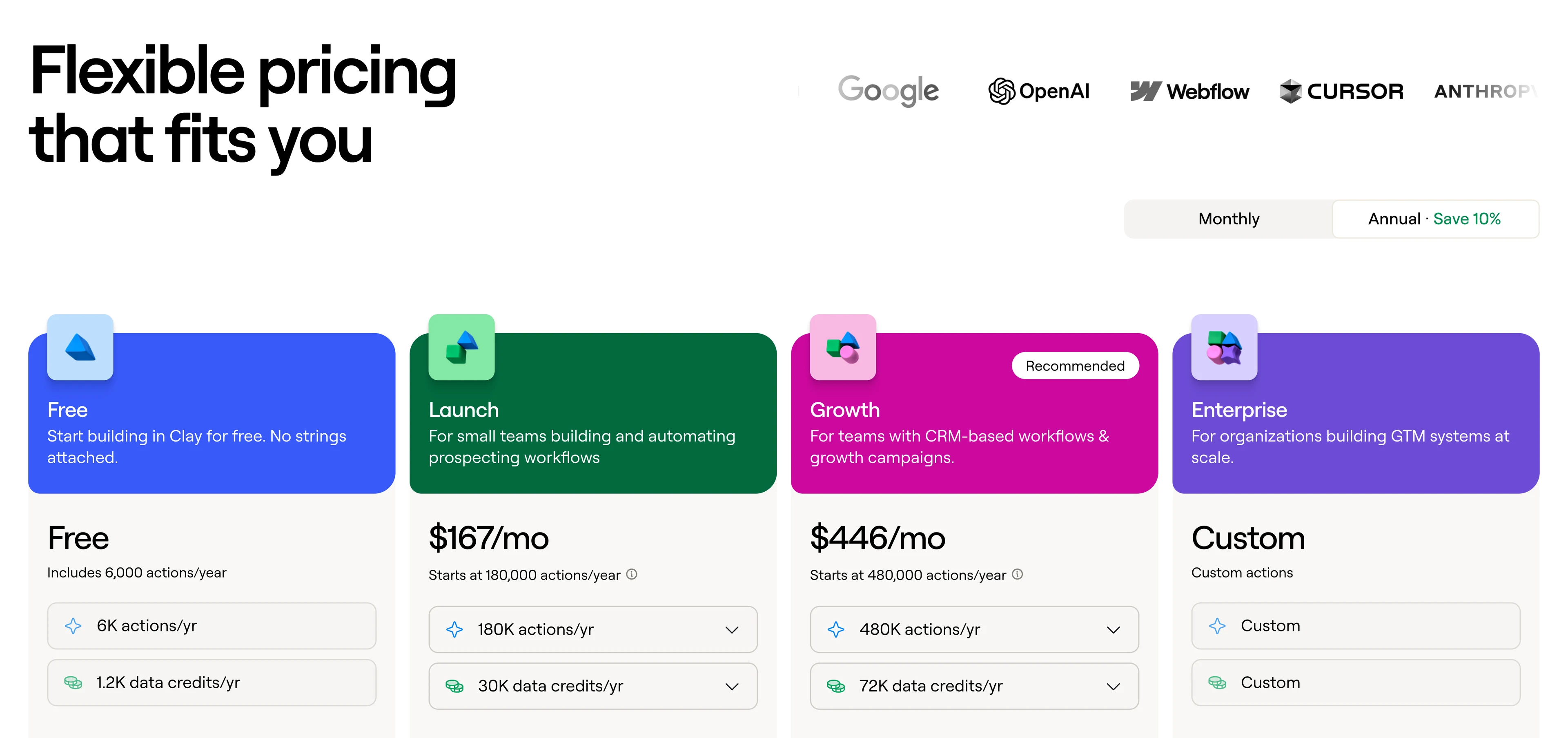
Price $167 to $446 a month, billed annually
Key takeaways
  • Apollo charges per seat: 5 reps on Basic is $2,940 a year. A phone number costs 8 credits and unused credits expire each cycle.
  • Clay charges per plan, not per seat: Launch is $2,004 a year at 15,000 actions and 2,500 data credits a month. CRM sync needs Growth.
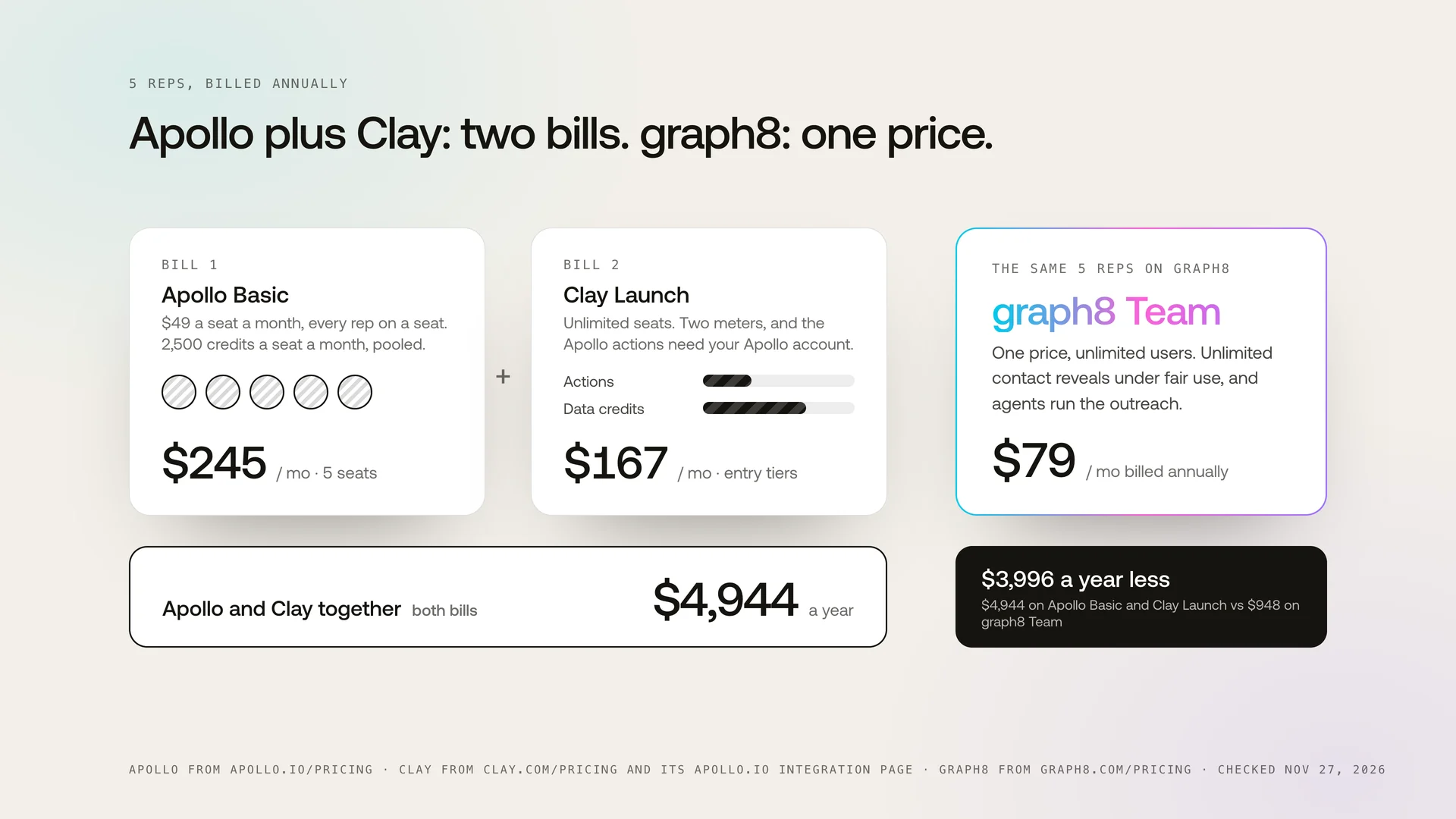
  • Clay can run Apollo inside a table, with your own Apollo account, so running both means paying both: $4,944 a year for 5 reps.
  • graph8 Team is $948 a year for the whole team, with unlimited contact reveals under fair use, the dialer and CRM sync included.
  • Apollo Basic, 5 seats$2,940a year
  • Clay Launch$2,004a year, any seats
  • Apollo and Clay together$4,944a year
  • graph8 Team$948a year, unlimited users
Compared

Apollo vs Clay compared: data, pricing, credits, outreach and ease of use

Five topics, one tab each. Every panel is a side-by-side with graph8 underneath, and every fact links to the vendor's own page.

Apollo vs Clay for data enrichment and list building

ApolloClaygraph8

ApolloIts own database: 240M+ contacts and 30M+ accounts. Search, filter and export to lists.

ClayNot a database. Buys data from 150+ providers with data credits, in waterfalls you set up, and can include Apollo with your own account.

graph8700M+ contacts and 100M+ companies, free to search with 50+ filters. Reveals unlimited on Team under fair use.

ApolloWebsite visitors: identify 20 companies a month on Free, 100 on paid plans.

ClayFree has no phone number enrichment. Launch adds phone enrichment, job changes and signals.

graph8Team includes unlimited website visitor identification.

Sources: Apollo pricing (checked November 24, 2026), Clay pricing and Clay: Apollo.io integration (checked November 27, 2026), graph8 pricing.

Cost calculator

Apollo vs Clay cost calculator: one, the other, or both

Pick your team size and plans. Apollo grows with every seat; Clay and graph8 stay flat because seats are unlimited. Running Apollo inside Clay means paying both.

Apollo plan
Clay plan
  1. graph8 TeamUnlimited users, one price
    $948/yr
  2. Apollo BasicPer seat
    $2,940/yr
  3. Clay LaunchUnlimited seats
    $2,004/yr
  4. Apollo and Clay togetherClay's Apollo actions need your own Apollo account
    $4,944/yr
Apollo credits, pooled
12,500 a month
That is 1,562 phone numbers at 8 credits each, if nothing else spends them
Clay data credits
2,500 a month
Plus 15,000 actions, shared across unlimited seats
graph8 Team
Unlimited reveals
Contact reveals unlimited under fair use, for every user
The same 5 people on graph8 Team: $3,996 a year less than Apollo and Clay together Start Free

Annual billing, entry usage tiers, checked November 27, 2026. Sources in the method below.

Animation: 5 reps on Apollo Basic at $245 a month plus Clay Launch at $167 a month come to $4,944 a year, against graph8 Team at $79 a month
Running Apollo and Clay together for 5 reps, next to graph8 Team.
Read what the video shows
  1. Bill 1: Apollo Basic, $49 a seat a month billed annually, 5 seats: $245 a month, 2,500 credits a seat a month, pooled.
  2. Bill 2: Clay Launch, $167 a month billed annually, unlimited seats, two meters: actions and data credits. Clay's Apollo actions need your own Apollo account.
  3. Together: $4,944 a year.
  4. graph8 Team: $79 a month billed annually, unlimited users and unlimited contact reveals under fair use. $3,996 a year less.
Using both

Can you use Apollo and Clay together?

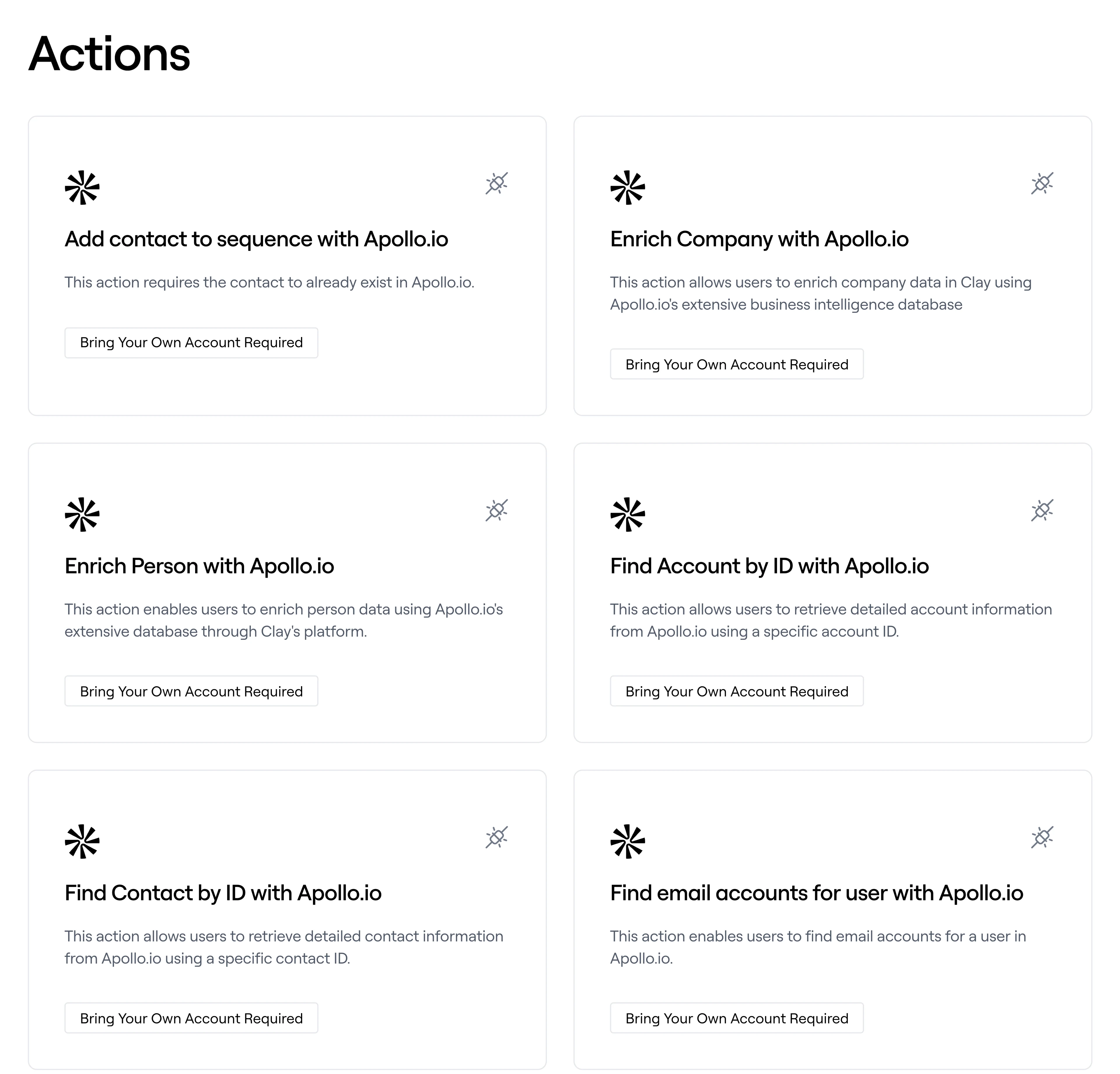
Yes. Clay has a native Apollo.io integration with 14 actions. Every one needs your own Apollo account, so you pay for both tools.

Clay's Apollo.io actions Bring your own account

Enrich

  • Enrich Company with Apollo.io
  • Enrich Person with Apollo.io
  • Find Open Jobs with Apollo.io

Find

  • Find People with Apollo.io
  • Find People at Company By Job Title with Apollo.io
  • Find Account by ID with Apollo.io
  • Find Contact by ID with Apollo.io
  • Find Saved Contacts with Apollo.io

Write back to Apollo

  • Find or Create Contact with Apollo.io
  • Update contact with Apollo.io
  • Add contact to sequence with Apollo.io
  • Update contact status in sequence with Apollo.io

Account lookups

  • Find email accounts for user with Apollo.io
  • Find user id by email with Apollo.io

From Clay's Apollo.io integration page, checked November 27, 2026.

  1. 1Enrichment runs on your own Apollo account
Clay's Apollo.io integration page: native actions such as Enrich Company and Enrich Person with Apollo.io, each marked Bring Your Own Account Required

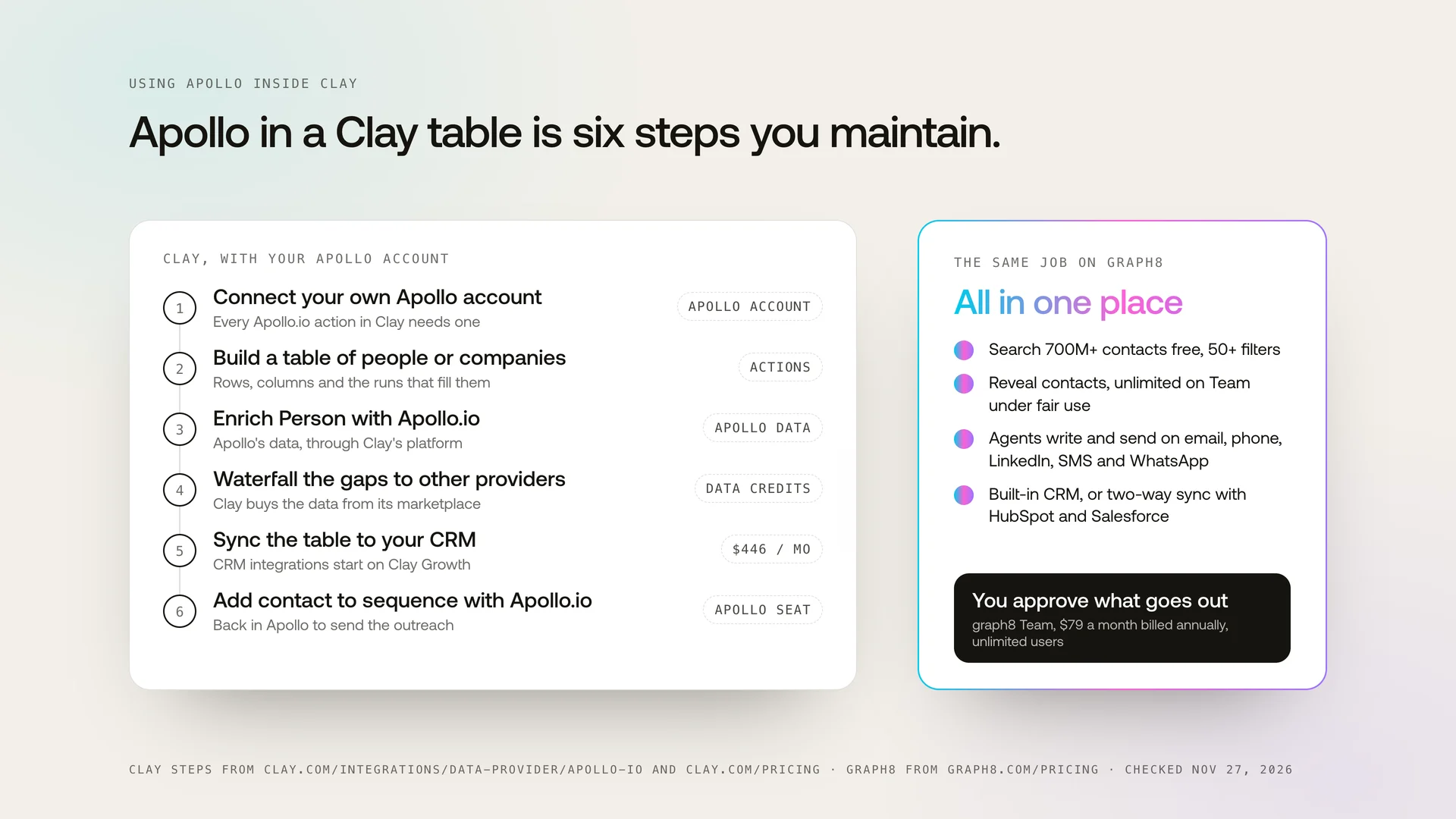
Apollo becomes one step in a Clay table: enrich people and companies from Apollo, waterfall the gaps to other providers, then push contacts back into an Apollo sequence. It fills gaps, and it stacks costs and upkeep: Apollo seats, the Clay plan, and someone to maintain the table.

graph8 starts from the other end. Its own 700M+ contacts are free to search, reveals are unlimited on Team under fair use, and the outreach runs in the same place.

Start Free
Animation: six steps to run Apollo inside a Clay table, each with what it costs, then the same job on graph8 in one place
What running Apollo inside Clay takes, next to the same job on graph8.
Read what the video shows
  1. 1. Connect your own Apollo account: every Apollo.io action in Clay needs one.
  2. 2. Build a table of people or companies, which spends actions.
  3. 3. Enrich Person with Apollo.io, on your Apollo account.
  4. 4. Waterfall the gaps to other providers, paid in data credits.
  5. 5. Sync the table to your CRM: CRM integrations start on Clay Growth, $446 a month billed annually.
  6. 6. Add contact to sequence with Apollo.io, back in Apollo to send.
  7. On graph8: search 700M+ contacts free, unlimited reveals on Team under fair use, agents send on five channels, built-in CRM or two-way sync. You approve what goes out.
Who it's for

Clay vs Apollo for sales prospecting: who each one suits

The signals that point to each, from a Series A sales team to a RevOps group that builds.

graph8

Teams that want prospecting run for them

  • Data and outreach in one place, with no seat fees
  • Agents research, write and send; you approve what goes out
  • Phone numbers at no extra cost on Team under fair use
  • Agencies and high volume: Platform, $399 a month billed annually, 75,000 credits
Start Free
Apollo

Small sales teams that want one tool today

  • Reps search, list and sequence without building anything
  • You are fine paying per seat as you hire
  • Your volume fits the credits each seat includes
  • You want a free plan to try it first
Clay

RevOps teams that build enrichment

  • Someone owns tables, waterfalls and providers
  • You want many providers, including Apollo with your own account
  • Unlimited seats matter more than a simple bill
  • You can forecast actions and data credits
Switching

How to switch from Apollo or Clay to graph8

Five steps, no migration project. Your CRM stays where it is.

Most teams run graph8 next to their current tools for a cycle, then move over when the contract allows.

  1. 01

    Check your renewal dates

    Apollo credits expire at the end of each cycle, so use them before you cancel. Clay keeps part of your credits on rollover, so plan your last cycle around it.

  2. 02

    Export what you need

    Apollo lists and sequences, Clay tables, and contact and company records, before access ends.

  3. 03

    Start graph8 free

    Sign up with your work email in about ten seconds. No credit card.

  4. 04

    Connect your CRM and mailbox

    graph8 syncs both ways with HubSpot, Salesforce, Pipedrive, Outreach and Salesloft, so your records stay where they are.

  5. 05

    Rebuild your lists and launch

    Search is free, so recreate your target lists with 50+ filters, then approve your first campaign and let the agents run it.

graph8 pricing, unlimited users on every plan Compare every feature
  1. For verified companies Free
    Free forever
    No credit card
    • 5,000 starter credits as you get set up
    • 250 credits a month
    • Unlimited website visitors and form capture
    • AI web chat and AI receptionist
    Start Free
  2. To scale outbound Team
    $99 / mo
    $79/mo billed annually
    • 10,000 credits a month
    • Unlimited contact data, fair use
    • Mailboxes, domains and LinkedIn accounts
    • Dialer and outbound calling
    Start Team
  3. For high volume and agencies Platform
    $499 / mo
    $399/mo billed annually
    • 75,000 credits a month
    • Everything in Team
    • Lowest credit price, $0.0067
    • Agency client workspaces
    Start Platform
Method

How we compared Apollo and Clay

Published bygraph8
Last checkedNovember 27, 2026
  1. We read each vendor's own pricing and integration pages in a browser (Apollo on November 24, 2026, Clay on November 27, 2026) and quote only what they publish.
  2. The calculator uses annual billing at each plan's entry usage. It does not convert between Apollo credits and Clay data credits, because Clay does not publish a data-credit price per contact.
  3. Running both assumes every rep keeps an Apollo seat, since Clay's Apollo.io actions need your own Apollo account.
  4. Each pricing page is saved as a dated screenshot, and every fact keeps a proof phrase. A script re-reads the sources and flags any phrase that changes; facts older than 90 days are flagged for a re-check.
  5. graph8 publishes this page. graph8's own prices come from its pricing page.
Check this page with AI

Apollo checked November 24, 2026

Clay checked November 27, 2026

graph8 checked November 27, 2026

FAQ

Apollo vs Clay: frequently asked questions

What is better, Apollo or Clay?

It depends on who does the work. Apollo is better when reps search one database and send sequences from the same tool: 240M+ contacts and 30M+ accounts, from $49 a seat a month billed annually. Clay is better when someone on the team builds enrichment workflows across 150+ providers, from $167 a month with unlimited seats. If you want the data and the outreach without per-seat pricing or tables to maintain, graph8 Team is $79 a month billed annually for unlimited users.

Can Apollo and Clay be used together?

Yes. Clay has a native Apollo.io integration with 14 actions, and every one says "Bring Your Own Account Required". You can enrich people and companies with Apollo inside a Clay table, then add contacts to an Apollo sequence. You pay for both: for 5 reps, Apollo Basic and Clay Launch come to $4,944 a year billed annually.

Can I use Apollo data inside Clay?

Yes, with your own Apollo account. Clay's Apollo.io actions include Enrich Person, Enrich Company, Find People at Company By Job Title and Find Open Jobs, and they run on the Apollo account you connect.

How much do Apollo and Clay cost?

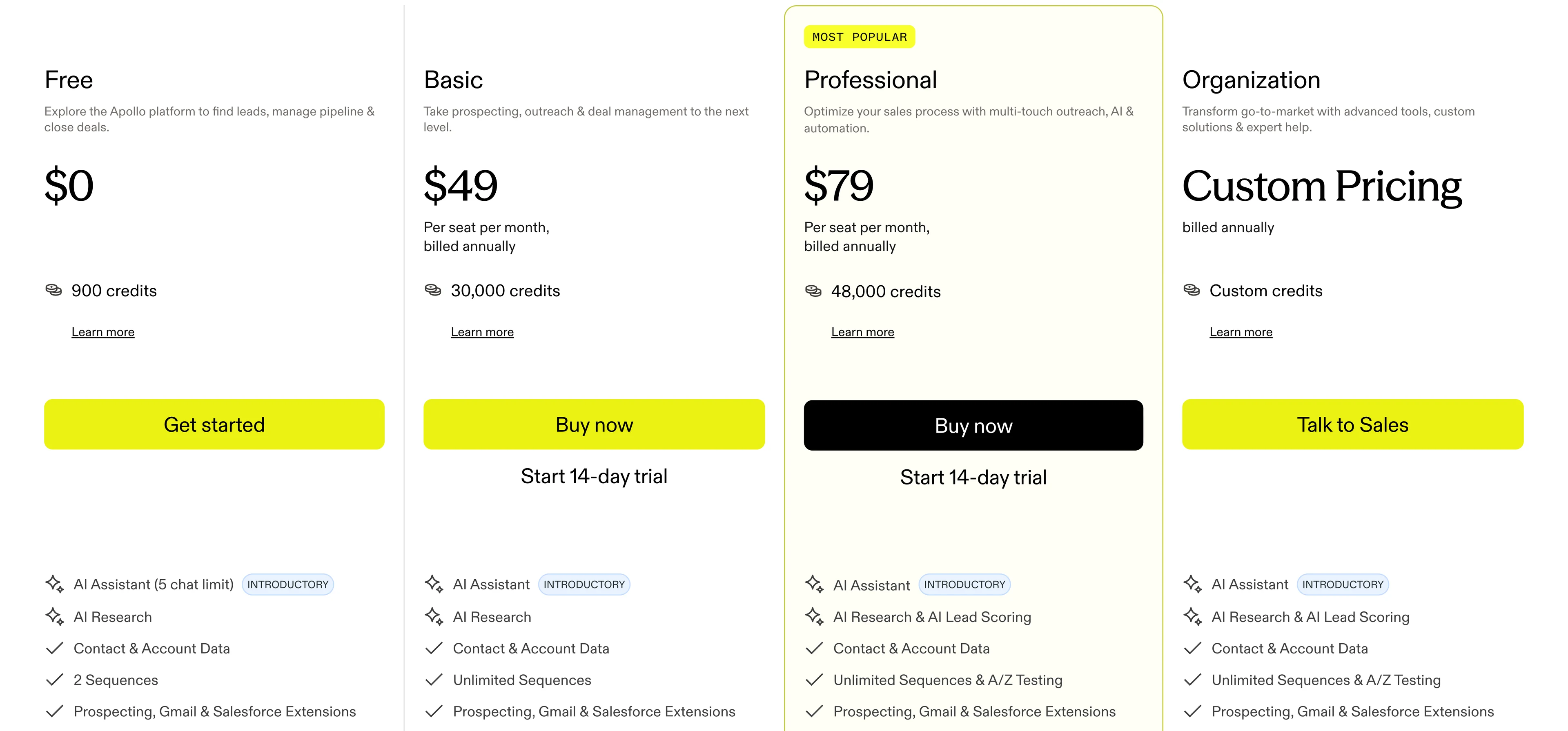
Apollo Basic is $49 and Professional $79 a seat a month billed annually ($65 and $99 monthly), with a free plan. Clay Launch is $167 and Growth $446 a month billed annually ($185 and $495 monthly) at entry usage, with unlimited seats and a free plan. graph8 Team is $79 a month billed annually for unlimited users.

Is Clay harder to learn than Apollo?

Usually, yes. Apollo is a database with search filters and sequences, so reps can start on day one. Clay is a table you design: you choose providers, set up waterfalls and manage two usage units, actions and data credits. On graph8, an agent sets up the account with you in a conversation, and agents run the outreach while you approve what goes out.

Which has better data, Apollo or Clay?

They get data differently. Apollo sells its own database of 240M+ contacts and 30M+ accounts. Clay is not a database: it buys data from 150+ providers with data credits, and can include Apollo with your own account. graph8 has 700M+ contacts and 100M+ companies, free to search on every plan.

Does Apollo include a dialer?

Yes. Apollo's US dialer uses 1 credit per 30 seconds, and its Advanced Dialer add-on (parallel, power and international dialing, local presence) is $119 a team a month billed annually. graph8 Team includes the power and parallel dialer.

Does Clay have built-in outreach?

For email, yes. Clay's FAQ lists the Clay Sequencer for email on the Free plan, and its plan table starts email campaigns, in Clay or through an email provider integration, on Launch. It can also add contacts to an Apollo sequence with your own Apollo account. graph8 agents run email, phone, LinkedIn, SMS and WhatsApp from one place.

Do Apollo and Clay credits roll over?

Apollo credits do not: unused credits expire at the end of each billing cycle, including purchased add-on credits. Clay's plan table says up to 1 month's credits roll over on monthly billing and 15% of annual credits on annual billing, and its FAQ says Launch and Growth balances can reach 2x the monthly amount. Clay top-ups cost a 30% premium.

Apollo or Clay for a small outbound team?

For a small team that wants to send this week, Apollo is quicker to start, but you pay for every seat: 5 reps on Basic is $2,940 a year. Clay Launch is $2,004 a year for any number of seats, but someone has to build the tables. graph8 Team is $948 a year for the whole team, with the data, the dialer and agents that run the outreach.

Is Apollo.io outdated?

Not by its own measure: Apollo's pricing page shows 4.7/5 based on 9,690 reviews and lists new AI features as introductory. Teams that compare it with Clay usually cite pricing, not age: phone numbers at 8 credits, credits that expire each cycle and every seat on the same plan.

What is the best alternative to Apollo and Clay?

For most teams, graph8: free search of 700M+ contacts, unlimited users, unlimited contact reveals on Team under fair use for $79 a month billed annually, and agents that run email, phone, LinkedIn, SMS and WhatsApp while you approve what goes out. graph8 publishes this page, and every Apollo and Clay fact on it links to their own pages.
Apollo and Clay alternative

The data and the outreach, one price

Search 700M+ contacts free, add unlimited contact reveals on Team for $79 a month billed annually with unlimited users, and let the agents run the outreach. No credit card to start.